Hawks do not retrieve prey
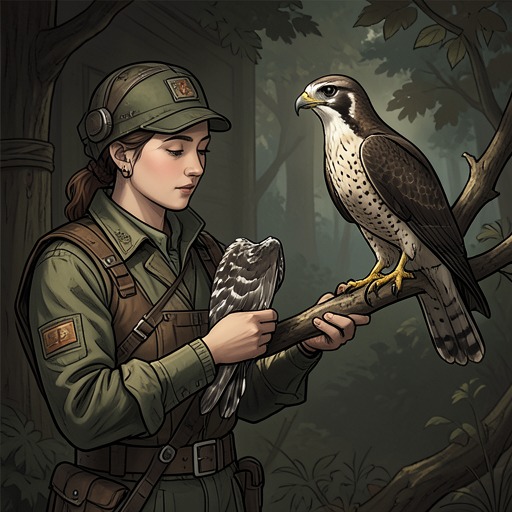
H is for HawkHawks do not retrieve prey is a practical rule that shapes what happens after a successful hunt: the falconer, not the hawk, must cross the ground to the catch. The rule turns recovery into part of the work of flying a hawk. In the account of Mabel’s hunt, that work requires close attention to feeding, a return to the glove, and the next day’s flight.
How the rule works
At a field overrun with rabbits, Mabel takes one in less than a minute, deep in a drift of nettles. Macdonald runs to her, parts the stems, and lifts the hawk and prey together onto the grass. The catch is not carried back by the bird. Instead, the falconer must approach, allow the hawk to eat for a while, and then bring her back onto the glove for a food reward.
The timing matters. If Mabel eats too much, she will not fly the following day. Macdonald therefore uses what the book describes as an ancient falconer’s trick to prevent the hawk from experiencing the change as the loss of her prize. She cuts off a hind leg and conceals it behind her back, stacks handfuls of grass beside her, then offers the leg on the glove while covering the rabbit with grass. Mabel looks down at the grass, looks up at the food, jumps to the glove, and eats. The procedure makes the falconer’s intervention part of the feeding routine rather than a simple attempt to take the catch away.
The kind of work the rule entails
The rule belongs to a form of falconry in which the human has to move into the scene of the hunt. Goshawks hunt with a quick dash from the fist at close range, and can be flown in many places; falcons, by contrast, need broad open spaces for their flights. Macdonald connects that difference in practice to differences in access to land: the expanses suited to flying falcons were not readily available without wealth or social connections. The goshawk’s closer-range hunting makes the falconer’s direct involvement at the catch especially visible.
That involvement also depends on observing the bird rather than treating the rule as a mechanical sequence. Elsewhere, Macdonald describes learning to read changes in a hawk’s posture and feathers, and distinguishes Mabel’s frustration from fear when she suddenly bates during a feeding lesson. Such attention matters to the return from prey: the falconer must respond to the bird’s actions while carrying out the practical steps that bring her back to the glove.
What the rule reveals
The rabbit hunt shows that a hawk’s success does not end the human’s work. The falconer must reach the bird, handle the transition from catch to glove, and regulate the meal in view of a future flight. The rule therefore describes an interdependent practice: the hawk pursues and holds the quarry, while the human supplies the movement, timing, and food exchange needed to continue training.
The episode also resists reducing Mabel to a predictable instrument. Her actions shape the sequence, while Macdonald’s knowledge of falconry gives her a way to respond without simply interrupting the bird’s feeding. The rule is practical, but in the narrative it makes the human’s responsibility unmistakable: a successful hunt still requires attention to what the hawk does next.